
Hey there, if you’re facing charges related to online solicitation of a minor in Texas, I want you to know you’re not alone—and there’s help available. I’m Chelsi McLarty, a dedicated criminal defense attorney at The McLarty Law Firm in Fort Worth, Texas, serving all of Tarrant County. I’ve been recognized as a Top Attorney by Fort Worth Magazine every year since 2014, selected as a Super Lawyer Rising Star by Thomson Reuters from 2019 through 2025, and inducted into the Eldon B. Mahon Inn of Courts in 2023. I’ve also been featured in Fort Worth Magazine’s Women Who Forward article and honored as a top attorney by 360 West magazine. What drives me is my serious commitment to getting to the bottom of every case, tailoring a defense strategy that fits your unique situation, and fighting diligently from arrest to resolution—whether that’s negotiating a better outcome, exploring diversion programs, or taking it to trial if needed. My goal is always to protect your future and help you move forward.

Online Solicitation of a Minor in Texas | Penal Code 33.021
Online solicitation of a minor is a serious felony offense in Texas, outlined under Texas Penal Code § 33.021. This law addresses sexually explicit communications with someone under 17 years old, as well as soliciting a minor to meet up for sexual activity. It’s important to understand that these charges can stem from online interactions, like chats, emails, texts, or social media, and they carry heavy consequences, including prison time and mandatory sex offender registration. But with the right defense, there are ways to challenge these allegations and seek a fair resolution.
What is online solicitation of a minor in Texas?
Let’s break down what the law actually says. Under the statute, online solicitation of a minor happens when a person 17 years or older communicates in a sexually explicit way with someone they know or believe to be under 17, with the intent to commit a sexual offense. It also includes knowingly soliciting a minor—or someone believed to be a minor—to meet for sexual contact, sexual intercourse, or deviate sexual intercourse. A “minor” here means anyone under 17, or someone the offender believes is under 17. Importantly, for the solicitation to meet part, the offense is complete as soon as the solicitation is made—no actual meeting has to happen.
What Conduct Gives Rise to an Online Solicitation of a Minor charge?
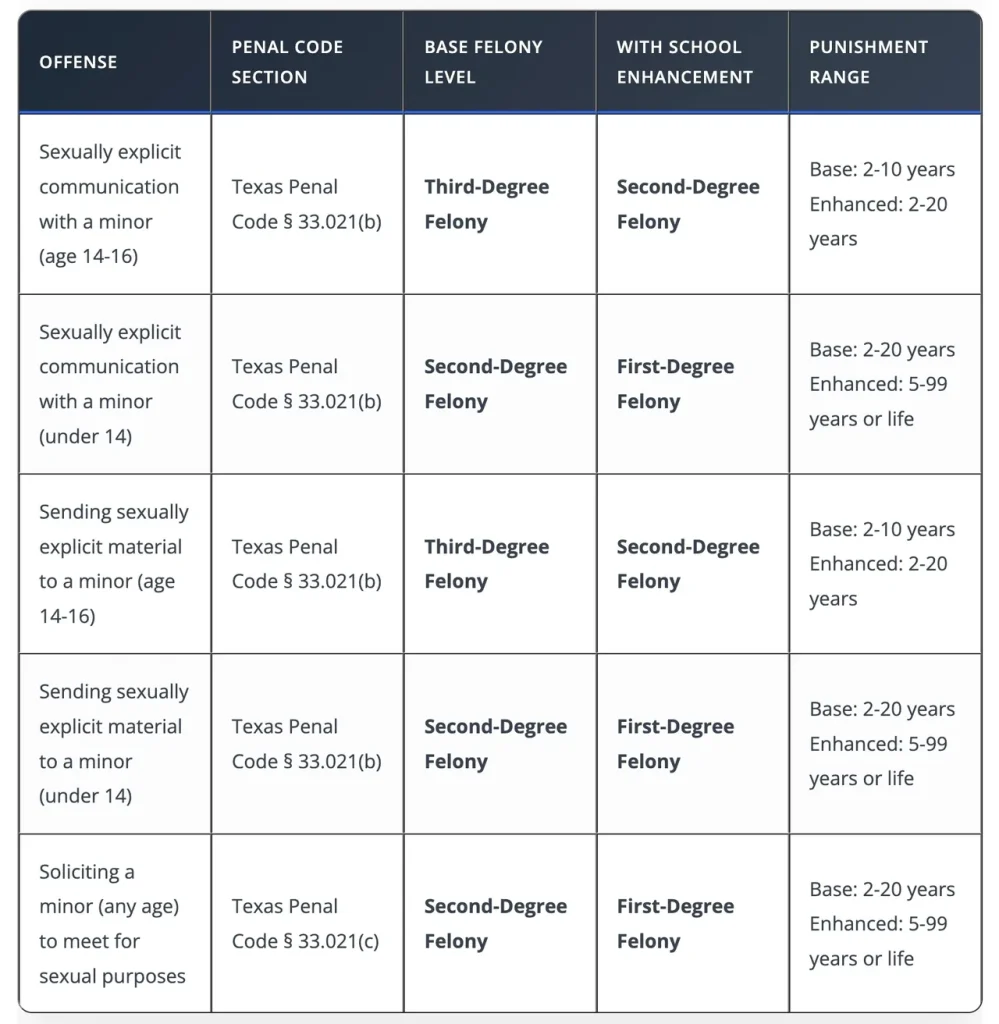
Penalties for these charges depend on the specifics. If it’s about sexually explicit communications or distributing explicit material to a minor who is 14 or older, it’s typically a third-degree felony, which can mean 2-10 years in prison and fines up to $10,000. But if the minor is under 14, it bumps up to a second-degree felony, with 2-20 years in prison and the same fine limit. Soliciting any minor under 17 to meet for sexual purposes is a second-degree felony right off the bat. There’s also a school enhancement under § 33.021(f-1): If the offense occurs during school hours and you knew or should have known the minor was enrolled in school, it increases the felony degree, potentially leading to 5-99 years or life for a first-degree felony. On top of that, a conviction requires lifelong sex offender registration, which can impact your job, housing, and more. These are tough penalties, but remember, every case has its details, and defenses can make a big difference.
Speaking of defenses, these cases often come from police sting operations where officers pose as minors online. Common defenses include entrapment, where law enforcement might have induced you to commit the crime in a way that overrode your will. Mistaken age can sometimes play a role, though it’s not always a full defense if the person was actually under 17. There are also statutory defenses in certain situations, like if you were married to the minor or not more than three years older and the minor consented—but these are limited, and things like educator-student relationships make it illegal regardless. Other strategies might involve challenging the evidence, like questioning the reliability of digital records, proving mistaken identity (maybe an account was hacked), or highlighting insufficient proof of intent. It’s all about scrutinizing the prosecution’s case to find weaknesses.
Is it illegal to be friends with a minor online?
No, simply being friends with a minor online isn’t illegal. The law targets sexually explicit communications or solicitations with sexual intent. Non-sexual, platonic friendships don’t fall under this statute, but if conversations turn sexual, it could cross the line and lead to charges.
What is the law on solicitation in Texas?
In Texas, solicitation generally refers to asking or encouraging someone to commit a crime, but in this context, it’s specifically about online solicitation of a minor under § 33.021. It prohibits sexually explicit online communications or soliciting meetings for sexual purposes with minors (or those believed to be minors). It applies to any electronic means, and charges can arise even from undercover operations without an actual child involved.
Can you charge someone for soliciting?
Yes, absolutely—you can charge (meaning prosecute) someone for soliciting under Texas law if their actions meet the elements of the offense, like online solicitation of a minor. These cases are often pursued vigorously by law enforcement, especially in sting operations, and can result in felony charges.
Who is a Minor for Purposes of Online Solicitation
A minor is defined as anyone under 17 years old, or someone you believe or who represents themselves as under 17. This includes scenarios where no real child is involved, like in police stings. Special rules apply to educator-student relationships, making it illegal regardless of other factors. Understanding this definition is crucial for building a defense.
What if there was no actual child involved in the Online Solicitation?
Many cases stem from undercover operations where officers pose as minors—no actual child needs to be involved for charges to stick. Agencies like local police, ICAC task forces, or federal entities run these stings. If this sounds like your situation, reaching out to a skilled attorney ASAP can help navigate the evidence and potential defenses.
Are there statutory defenses to Online Solicitation of a Minor?
Yes, there are a couple of built-in defenses: if you were married to the minor at the time, or if you weren’t more than three years older than the minor, they consented, and you weren’t required to register as a sex offender previously. However, these don’t apply in educator-student cases. Beyond statutes, factual defenses like lack of intent can also come into play.
What is the Punishment for Online Solicitation of a Minor in Texas?
Punishments are felony-level, including prison time, which can be 10-20 years, 2-20 years, or longer, depending on the case typically), fines up to $10,000, and mandatory lifelong sex offender registration. Registration affects your life long-term, from job opportunities to where you can live. But early intervention can sometimes lead to reduced charges or alternative resolutions.
How Does Online Solicitation of a Minor Become a Second Degree Felony?
It escalates to second-degree if the minor is under 14 for communication offenses, or anytime you’re soliciting a meeting with a minor under 17. The school enhancement can also push a third-degree up to a second-degree. Knowing these triggers helps in assessing your case.
Examples of Other Defenses to Online Solicitation
Beyond statutes, defenses include insufficient evidence (e.g., no proof of intent), mistaken identity (hacked account), or discrediting the investigation/witnesses. Each case is unique, so a thorough review is essential.
Are Online Solicitation of Minor Stings Entrapment?
Entrapment is possible if police overbore your will to commit the act, meaning they induced something you wouldn’t have done otherwise. It’s a viable defense in some stings but hard to prove; we evaluate inducement vs. predisposition.
What is the Statute of Limitations for Online Solicitation of a Minor in Texas?
The limit is three years from the offense date, giving prosecutors a window to charge. If time has passed, this could bar prosecution.
Does a conviction for online solicitation of a minor require sex offender registration?
Yes, even with probation or deferred adjudication, it requires at least 10 years of registration—often lifelong, depending on the case. This impacts daily life, but appeals or modifications might be options post-conviction.
What are police allowed to do in online solicitation sting operations?
Officers can pose as minors, lie about details, and use adults in ops. Arrests often occur at planned meetups, but charges can come from messages alone.
In conclusion, navigating the complexities of online solicitation of a minor charges in Texas under Penal Code § 33.021 demands a thorough understanding of the laws, potential penalties, and viable defenses—from entrapment in sting operations to statutory exceptions and evidence challenges. These allegations can upend your life with severe consequences like lengthy prison sentences, fines, and lifelong sex offender registration, but remember, every case has unique facets that a skilled defense can leverage to protect your rights and future. Whether it’s scrutinizing the prosecution’s evidence, exploring mistaken beliefs about age, or fighting enhancements like the school clause, the key is acting swiftly with informed legal guidance to achieve the best possible resolution.
If you’re facing these serious charges in Tarrant County or beyond, don’t go it alone—contact The McLarty Law Firm today for a confidential consultation. As your dedicated advocate, Chelsi McLarty is committed to getting to the bottom of your case and crafting a personalized strategy.
Call us at (817) 900-3235, visit our website – https://mclartylawfirm.com/criminal-defense, or office at 855 Texas Street, Fort Worth, Texas 76102 (map coordinates: 32.7555° N, 97.3308° W). Let’s discuss your options and start building your defense right away—your future is worth fighting for.