

Fort Worth Theft Lawyer – Compassionate, Client-First Defense with Chelsi McLarty
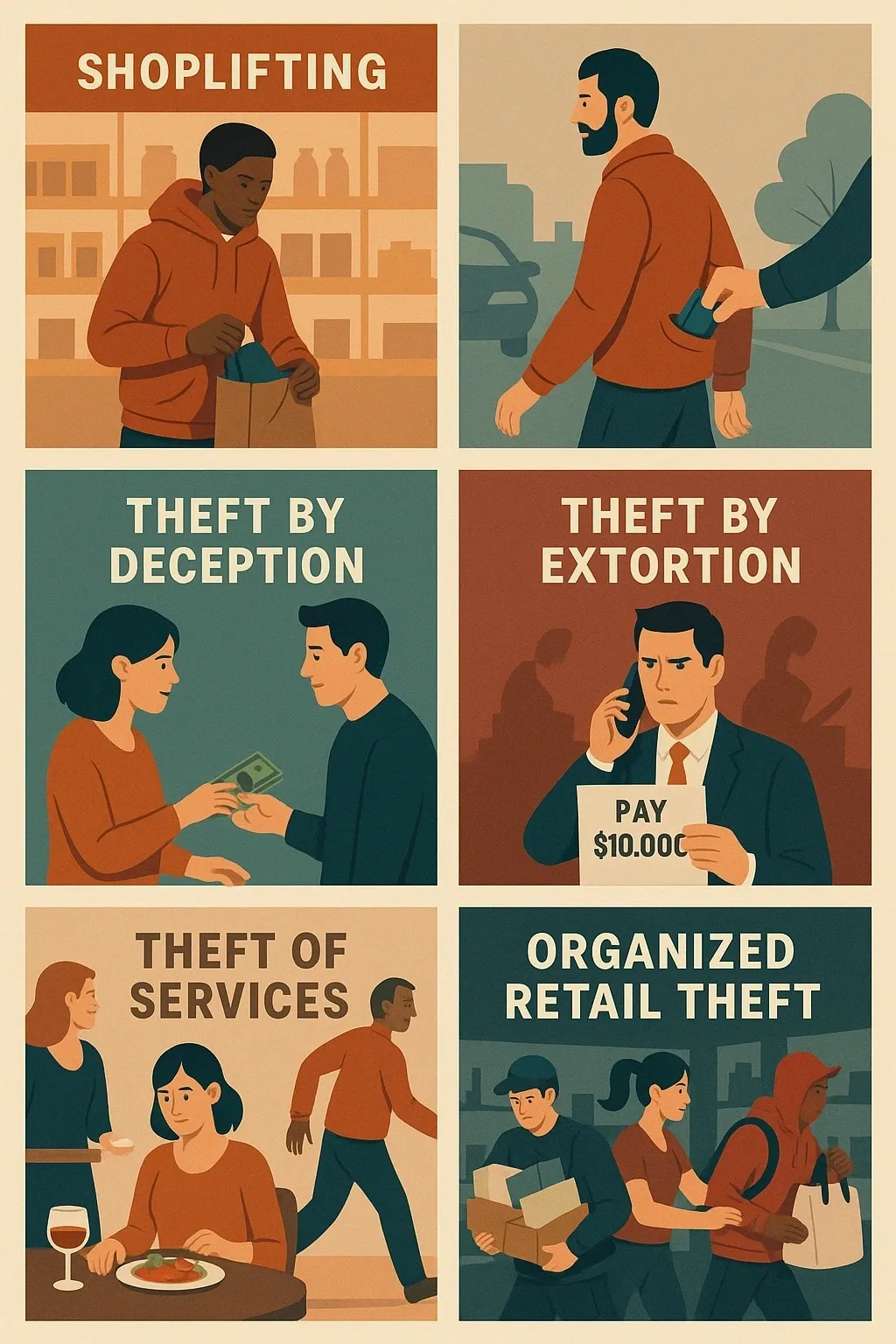
If you or a loved one has been arrested for theft in Fort Worth, you’re likely feeling scared, overwhelmed, and unsure where to turn. We get it. A theft charge isn’t just about the threat of jail time – even the accusation alone can tarnish your name and record. In times like this, you need more than just a lawyer; you need someone who truly understands what you’re going through and is ready to fight for you every step of the way. That’s exactly the kind of empathetic, client-first support that Fort Worth theft defense attorney Chelsi McLarty provides.
Chelsi has helped countless people facing theft charges in Tarrant County. She knows that good people can find themselves in bad situations, and one mistake or misunderstanding shouldn’t define your entire future. Her goal is always the same: protect you from jail, avoid a conviction on your record, and find a solution that lets you move forward with your life(ideally one that even allows your record to be cleared someday). In short, Chelsi McLarty’s approach is all about you – your story, your fears, and your best outcome.
What is Considered Theft in Texas?
Under Texas law (Texas Penal Code §31.03), theft is defined as “unlawfully appropriating (taking) property with intent to deprive the owner of that property.” In plain English, that means taking something that isn’t yours without permission and intending not to give it back. While that sounds straightforward, this definition covers a wide range of situations – from shoplifting a candy bar at the grocery store to stealing valuable trade secrets from a business.
Here are a few key points to understand about theft charges in Texas:
- It’s about intent: It doesn’t matter if you kept the item for five minutes or five years – what matters is that at the moment you took it you intended to deprive the rightful owner. If you took something by mistake or genuinely believed you had permission, that lack of intent could be a crucial fact for your defense.
- “Owner” is broadly defined: The “owner” isn’t just the person who originally bought the item. It can be anyone with a greater right to the property than you. For example, if you find a lost phone and someone else had already found it before and had possession, that person could be considered the owner relative to you. Taking it from them could still be charged as theft. Essentially, if it wasn’t yours to take, Texas law may consider it theft.
- No lawful justification: If you have any legal justification or claim of right to the property (like you honestly thought the property was yours), it might not be theft. But without a valid reason or permission, taking something can land you in handcuffs.
Texas has what’s called a “consolidated theft statute.” This means many different ways of unlawfully taking property (shoplifting, writing bad checks, embezzlement, etc.) are all charged under the general offense of “Theft” rather than as separate crimes. In the past, acts like swindling, extortion, or receiving stolen property were distinct offenses. Now, they’re usually prosecuted under the umbrella of theft. The bottom line is if you’re accused of any kind of wrongful taking of property or money in Fort Worth, it’s likely coming under the theft law.
Is Theft a Misdemeanor or Felony in Texas?
One of the first questions people have is whether a theft charge will be a misdemeanor or a felony. In Texas, this primarily depends on the value of the property or services allegedly stolen. Texas uses a value ladder(or theft classification ladder) to categorize theft offenses. Generally:
- Lower-value thefts are misdemeanors.
- Higher-value thefts become felonies.
However, prior convictions and certain circumstances can increase a theft charge to a higher level, even if the dollar value is low.
In Texas, the magic number for felony theft is typically $2,500. If the alleged value of the stolen property is $2,500 or more, the offense is usually charged as a felony. Below that, it’s usually a misdemeanor– unless you have past theft convictions that bump it up.
👉 Important: Two prior theft convictions (of any level) can elevate a new theft charge to a felony, regardless of the amount stolen. In other words, if you have two thefts on your record already, even getting caught stealing a $50 item (normally a Class C misdemeanor) could be charged as a state jail felony. Texas law takes repeat offenses seriously: a third strike, even for something small, can mean significant jail time. For example, stealing a pack of gum when you have two prior theft convictions could theoretically put you in state jail for up to 2 years – a shocking outcome given the trivial value, but that’s how Texas law is written.
There are also special situations where theft is treated more severely regardless of value. For instance, theft from a person (like pickpocketing or stealing something directly off someone, or even from a corpse or grave) is automatically at least a state jail felony, even if what you took was worth only $5. The law sees taking directly from a person as more dangerous or invasive, so it bumps the charge up.
The best way to know exactly what level of charge you’re facing is to consult with a knowledgeable attorney. Chelsi McLarty can evaluate your case details and tell you whether it’s likely a misdemeanor or felony, and what that means for potential punishment. Understanding the level of charge is critical because it determines what consequences are on the table.
Texas Theft Value Ladder: Charges and Penalties
Texas assigns penalties based on the dollar value of the stolen property or services. This is often shown as a “value ladder,” climbing from minor misdemeanors for low-value theft, up to serious felonies for high-value theft. Below is the Texas theft classification ladder with the offense level and the corresponding potential penalties:
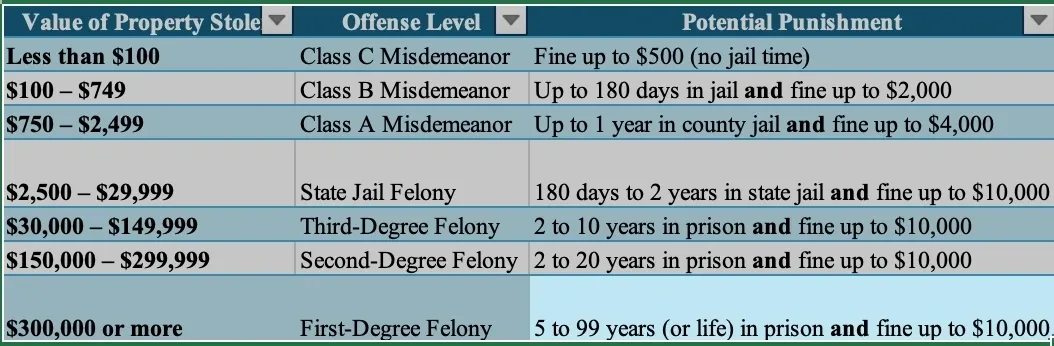
Looking at that ladder, you can see how the stakes get higher as the value increases. For example, stealing an item worth $800 is a Class A misdemeanor – you could be facing up to a year in jail. But stealing an item worth $3,000 is a state jail felony – now you’re looking at potentially 2 years in a state jail facility. And once values climb into the tens of thousands, you’re in true felony territory with the possibility of years in prison.
It’s not just prison time and fines that matter. Any theft conviction can also carry collateral consequences that might not be obvious at first. A theft on your record is seen as a crime of dishonesty, which can be a red flag for employers, landlords, and even universities. Here are some life impacts a theft charge or conviction can have:
- Employment: Many employers run background checks. A theft conviction (even a misdemeanor) can make it much harder to land a job, especially in positions of trust or handling money.
- Education: Colleges and vocational schools may deny admission or scholarships if you have certain convictions. Even if you’re already enrolled, a criminal record can affect professional licensing for careers like nursing, education, etc.
- Reputation: Let’s face it, a theft accusation can be embarrassing and stressful. You might feel judged by friends, family, or your community. Chelsi understands this and handles your case with discretion and respect.
- Civic Rights: If you are convicted of a felony theft, you lose certain civil rights, like the right to vote or serve on a jury, until those rights are restored after completion of your sentence. That’s a long-term consequence that people don’t always realize initially.
- Restitution: In many theft cases, part of the penalty will be paying restitution – essentially repaying the victim for what was taken or its value. This can be ordered in addition to fines.
- Immigration Status: If you’re not a U.S. citizen, a theft conviction can have immigration consequences, potentially affecting visas or residency status (the law considers many theft offenses crimes of moral turpitude).
Because the penalties and consequences vary so much depending on the specifics, it’s critical to know where you stand. When you consult Chelsi McLarty, she will clearly explain the exact charge against you and what the maximumpenalties are, as well as what outcomes are realistically likely in your situation. Knowledge is power – and part of Chelsi’s client-first approach is making sure you are informed and not left in the dark about your case.

Why You Need an Experienced Theft Defense Attorney
Being charged with theft can be life-altering, but you don’t have to face it alone. The Texas criminal justice system is complicated and intimidating, especially if it’s your first time dealing with it. Having a skilled theft defense lawyer by your side is important for several reasons:
- Guidance Through the Process: From the moment of your arrest until the resolution of your case, there are critical decisions to make (like how to plead, whether to negotiate or go to trial, etc.). There are deadlines, court appearances, and paperwork that can be confusing. Chelsi McLarty will guide you step-by-step, making sure you know what to expect and what you need to do.
- Protection of Your Rights: Unfortunately, mistakes or oversteps can happen during investigations and arrests. Police might try to question you in ways that violate your rights, or evidence against you might be shaky. Chelsi’s job is to protect your constitutional rights – for example, ensuring unlawful evidence isn’t used, and that you’re treated fairly by the prosecutor and court.
- Building a Strong Defense: Every theft case has its own story. Chelsi will thoroughly review the facts and evidence: the police reports, any video footage, witness statements, etc. She will listen to your side of the story, because often there’s more to it than what’s in the police report. With that information, she’ll craft a defense strategy tailored to your case – whether it’s negotiating for a lesser charge, pushing for a dismissal, or preparing a solid defense for trial.
At The McLarty Law Firm, our approach to theft cases is personal and results-driven. We aren’t here to judge you; we’re here to help you. Chelsi McLarty focuses on three primary goals for every client facing a theft charge:
- Keep You Out of Jail: We know that even a single night behind bars can be one of the worst experiences of your life. Chelsi’s first priority is to fight to keep you free while your case is pending and to avoid any incarceration as part of the outcome. This might involve arguing for a reasonable bond or even a release on personal recognizance early on, and later on, seeking alternatives to jail like probation or diversion programs.
- Protect Your Record: Chelsi understands how a permanent criminal record can wreck future opportunities. Avoiding a conviction is often just as important as avoiding jail. She will explore options like pretrial diversion, deferred adjudication, or negotiating a lesser offense – anything to prevent a final conviction that sticks on your record. If the evidence is weak, she won’t hesitate to seek a full dismissal or fight the charge at trial to keep your record clean.
- Help You Move Forward (Expunction/Non-Disclosure): The ideal end to a theft case is one that qualifies for expunction (erasing the record of the arrest and charge) or at least a non-disclosure (sealing the record from public view). Chelsi always keeps an eye on the long game – finding a resolution that not only solves the immediate problem but also sets you up to restore your life afterward. For example, if we can get your case dismissed or deferred, Chelsi will later help you expunge or seal the record so you can truly put this behind you.
All of this boils down to one thing: Chelsi McLarty puts her clients first. She is a Fort Worth theft lawyer who truly cares about youand your future. When you hire Chelsi, you’re not just getting a lawyer with deep knowledge of Texas theft law – you’re also getting a compassionate ally who will listen to your concerns, answer your questions in plain language, and make your fight her fight.
Common Types of Theft Charges in Texas
Shoplifting and Price Tag Switching
Shoplifting is the classic form of theft – taking merchandise from a store without paying. This could be anything from putting items in your purse or pockets and walking out, to more elaborate schemes. A specific type of shoplifting that Texas highlights is price tag switching. This is when someone tampers with price tags to pay less than an item is worth (or tries to get a higher refund by using a switched tag).
In the past, price tag switching was always a misdemeanor in Texas, no matter the value difference. But that changed in 2019. Now, under Texas law (House Bill 427), the punishment for price tag switching is based on the differencebetween the correct price and the price paid, and it’s treated the same as any other theft of equivalent value. That means if someone underpays by a large amount, they could theoretically face felony charges just like if they had shoplifted an item of that value. (Extreme example: Underpaying by tens of thousands of dollars could, in theory, lead to a first-degree felony theft charge – up to 99 years in prison – though a scenario that drastic is highly unlikely.) The key takeaway: shoplifting, including schemes like switching tags, is taken very seriously in Texas, and penalties will depend on the retail value involved.
Chelsi McLarty often sees clients who made a split-second poor decision at a store or were wrongfully accused by a loss prevention officer. She approaches these situations with understanding – sometimes people fall on hard times or just use bad judgment, and sometimes it’s a misunderstanding altogether. Whatever the circumstances, she works hard to minimize the consequences so a moment of mistake doesn’t ruin your life.
Theft from a Person
If you steal directly from someone’s person, Texas law ups the ante. This includes things like pickpocketing, snatching someone’s purse off their shoulder, or even taking an item from a corpse or grave. Under Texas Penal Code §31.03(e)(4)(B), any theft “from the person of another or from a human corpse or grave” is a State Jail Felony, regardlessof the item’s value. So, taking a $20 bill out of someone’s pocket as you lift their wallet would be charged more harshly than if you stole a $20 item off a store shelf. The rationale is that stealing from a person is more confrontational and risky (even if no violence is used, it’s one step away from robbery).
For you, this means if you’re accused of any theft where the allegation is you took something directly off someone (or from their immediate presence), you’re facing at least a felony. Chelsi McLarty has dealt with cases like these and knows how to challenge the evidence – for example, surveillance footage or eyewitness identification in pickpocketing cases can be unreliable, and if there’s doubt about who actually took the item, that can be used in your defense.
Theft with Prior Convictions (Repeat Theft)
As mentioned earlier, prior theft convictions can turn a misdemeanor into a felony. Here’s how it works in practice: If you get caught for a minor theft (say, shoplifting a low-cost item), normally that’s a Class B or C misdemeanor depending on the value. But if you have one prior theft conviction, prosecutors can bump the new charge up one level (so a Class C would become Class B, Class B would become Class A). If you have two or more prior theft convictions, the new charge can be escalated to a State Jail Felony(even if the new alleged theft is just a small amount).
These enhancements are there to penalize repeat offenders, but they can seem incredibly harsh. Chelsi understands that sometimes people convicted of theft in the past may have been struggling with issues like addiction, poverty, or other circumstances. If you’re now facing an enhanced charge, she will work to humanize your situation to the prosecutor and court – you are not just “a number” or “a repeat offender” to her. The goal will be to argue for leniency or an alternative resolution, especially if this current incident is minor or a sign you need help, not prison.
Also, note that theft charges can be enhanced for other reasons too, not just priors. Texas law imposes higher penalties if, for example, the theft was committed by a public servant in connection with their duties, or if the theft was part of a contract with the government (like a contractor defrauding the government), or if the theft occurred during a disaster (looting after a hurricane, for example). These situations are less common, but Chelsi is well-versed in these nuances and can advise if any apply to your case.
Theft by Deception (Fraud)
Some theft cases involve deception rather than physically taking something. Theft by deception means that someone is accused of tricking or defrauding another person into voluntarily handing over property. The classic example is a scam: let’s say you tell someone you have a home repair business and they pay you $5,000 to fix their roof, but you never intended to do the work or never show up – that’s theft by deception. The victim willingly gave you the money, but only because of your lies.
In Texas, these scenarios still fall under the theft law, with the charges based on the value of what was taken. The difference is the evidence will revolve more around what promises or statements were made, and what intent can be proven. Good people can sometimes get caught in what looks like a deception case – maybe there was a business deal or contract that fell through, and now one side is accusing the other of never intending to hold up their end. The line between a broken contract and a criminal theft can be thin and requires careful analysis.
Chelsi’s approach in such cases is to show your side: maybe you didintend to do the work but ran into issues, or you delivered some of the services and the situation is more of a dispute than a scam. By gathering receipts, communications, and any proof of your good faith, she can often convince prosecutors that this isn’t a clear-cut theft and maybe belongs in civil court or should be resolved without harsh criminal penalties.
Theft by Extortion
Extortion is essentially using threats to obtain someone’s property. If you blackmail someone – “Give me $1,000 or I’ll leak your private photos” – and they give you the money, that’s theft by extortion. In Texas, extortion scenarios are also prosecuted under the theft statute (as part of the consolidated law). The law says if the consent to hand over property was induced by coercion, it’s theft. “Coercion” can mean a lot of things, like threatening to commit a crime, to injure someone, to accuse someone of a crime (classic blackmail), to ruin someone’s reputation, or to misuse your official power.
These cases can be sensitive. Often, there’s a backstory – perhaps the person accusing you felt pressured, but you might have had a legitimate claim or it was a misunderstanding. Chelsi McLarty will carefully dissect any communications (texts, emails, etc.) to see if what happened truly rises to the level of a criminal threat or if things have been blown out of proportion. Given the serious nature of anything that’s considered extortion, having a strong advocate is crucial. Chelsi will ensure that one heated exchange or attempt to collect a debt doesn’t unjustly turn into a felony theft charge against you.
Theft of Services
Theft isn’t just about physical stuff – you can also be charged with stealing services. Theft of services happens when someone obtains a service without paying when they were supposed to. This could involve things like: dining at a restaurant and walking out on the bill, using someone’s landscaping services and never paying, or more subtly, using trickery to get utilities (water, electricity, cable) without paying. Even failing to return rental property (like equipment or furniture) can fall under theft of services if it was under a rental agreement.
Texas Penal Code §31.04 covers theft of service. One example given in the law: if you write a check for a service knowing it’ll bounce (insufficient funds) and then don’t make good within 10 days of notice, it’s presumed you intended to avoid payment. There’s also a specific defense: if a service provider accepted a post-dated check and then cashed it early (before the date), and it bounced, that’s not on you – the law says that can be a defense, because the deal was they’d wait until that date.
Chelsi has seen cases like these often in landlord-tenant contexts or utility theft situations. The key is often showing you didn’t mean to steal the service – maybe a financial hardship hit and you couldn’t pay, which, while a breach of contract, isn’t the same as a pre-planned theft. Or maybe there was a genuine misunderstanding with a contract. By digging into the details, she can often negotiate these cases down, sometimes even into civil settlements or dismissals if restitution is paid, rather than criminal convictions. Keeping a theft of service off your record can be just as important as any other theft, especially if you work in a field that requires trust.
Organized Retail Theft
Organized retail theft is basically shoplifting on steroids. It refers to schemes where one or more people work together to steal merchandise from retail stores, or where someone knowingly resells or distributes stolen merchandise. Texas Penal Code §31.16 specifically addresses this. For example, if a group of people goes store to store stealing items to resell online, or an employee skims items from inventory to sell out the back door, those could be charged as organized retail theft. Even just possessing lots of stolen retail merchandise can trigger this charge if they suspect you’re stockpiling it to sell.
The law sets the level of offense by the total value of merchandise involved, and interestingly it mirrors the same value ladder:
- < $100: Class C misdemeanor
- $100 to < $750: Class B misdemeanor
- $750 to < $2,500: Class misdemeanor
- $2,500 to < $30,000: State Jail Felony
- $30,000 to < $150,000: Third-degree Felony
- $150,000 to < $300,000: Second-degree Felony
- $300,000 or more: First-degree Felony
So effectively, organized retail theft is punished the same as regular theft in terms of value, but prosecutors might charge it to signal it was a coordinated or professional operation. They may throw in additional counts for each instance or involve federal agencies if it’s a big ring.
If you’re accused of organized retail theft, it can feel like they’re painting you as a criminal mastermind even if you just got caught up with the wrong crowd or were doing small-time shoplifting. Chelsi McLarty will make sure the punishment level matches the reality of the situation. If you’re not a major thief and this isn’t organized crime in the way they’re implying, she’ll fight to get it treated like a regular theft or reduced. She will also hold the State to its burden to prove you were actually working in concert with others or involved in a larger scheme, which can sometimes be hard for them to do.
How Are Stolen Property Values Determined?
You might wonder, “How do they decide what the stolen property is worth, especially if it’s used or damaged or an intangible service?” Great question. In Texas, the value is usually based on fair market value — basically, what the item or service would sell for in an open market at the time and place of the offense. If that’s hard to determine, they might use the cost of replacement (what it would cost to replace the item within a reasonable time after the theft). For services, it could be the standard rate for those services.
Sometimes the type of property can affect charges too. For instance, stealing certain items like ballots, firearms, or livestock can trigger specific provisions, but those are less common. Generally, however, it comes down to a dollar figure that then points to the penalty ladder we discussed.
Chelsi will scrutinize the value the prosecution is claiming. If you’re being charged with a felony because they say something was worth just over $2,500, you can bet she’ll investigate that valuation – maybe the item was actually worth less, which could knock the charge down to a misdemeanor. Value isn’t always black-and-white, and there’s room to argue especially with used items (like electronics, vehicles, etc.). Every dollar can count when it’s near a cutoff between charge levels.
Also, keep in mind, restitution (repaying the victim) is often calculated based on that same value. So getting a fair appraisal of the property’s worth is important not just for the criminal charge but for what you might owe the alleged victim if convicted.
Potential Defenses to Theft Charges
When you’re facing a theft allegation, it might feel like everyone has already decided you’re guilty. But you have rights and options. There are numerous defenses and strategies that Chelsi McLarty can explore to fight a theft charge. Here are some of the common defenses in theft cases:
- Lack of Intent / Mistake: Perhaps you didn’t mean to steal anything. Maybe you walked out of a store and honestly forgot you had an item in your cart, or you thought an item belonged to you when it actually didn’t. If the prosecution can’t prove you intentionally meant to deprive the owner, that’s a strong defense. Chelsi might use receipts, witness statements, or your own credible testimony to show it was a misunderstanding.
- Claim of Right / Ownership or Consent: If you sincerely believed the property was yours, or had permission to take it, then it’s not theft. For example, if a friend told you that you could borrow an item, but later someone thought you stole it – that could be a big misunderstanding. Or maybe you were reclaiming something you thought you had a rightful claim to. If evidence shows you had an honest claim of right or the owner’s consent, that can defeat a theft charge.
- Duress / Coercion: If you were forced or threatened into committing the theft by someone else, the law may excuse your actions. Maybe a person threatened harm to you or your family if you didn’t steal something for them. It’s not an easy situation to be in, and it’s not truly voluntary. Chelsi can present evidence of threats or coercion (texts, a history of abuse, etc.) to show you weren’t acting of your own free will.
- Insufficient Evidence: Sometimes, the simplest defense is that the State just can’t prove the case beyond a reasonable doubt. Perhaps there’s no clear video or eyewitness; maybe the fingerprint or DNA evidence isn’t conclusive, or the item was never recovered on you. Chelsi will attack the weaknesses in the prosecution’s evidence. Remember, it’s their job to prove you did it – if they can’t, you should not be convicted.
- Mistaken Identity / Alibi: Theft often happens quickly, and mistaken identity is possible – maybe someone who looks like you was the culprit, or you were simply in the wrong place at the wrong time. If you have an alibi (evidence you were somewhere else when the theft happened) or other proof that you aren’t the person who committed the crime, that’s a complete defense. Even short of an alibi, Chelsi can raise doubts, for example by questioning an eyewitness’s ability to see the suspect clearly.
- Police Procedure Violations: Chelsi will also examine how the evidence was obtained. If the police searched you or your property without a lawful warrant or probable cause, or questioned you without reading your rights, some or all of the evidence might be thrown out. Challenging an illegal search (say, if the stolen items were found in your home or car without a proper warrant) can sometimes gut the prosecution’s case.
Every case is different, and the applicable defenses will depend on the facts. Chelsi McLarty’s job is to identify the best defense angle for your situation. Often, it’s not just one defense, but a combination – for instance, asserting your lack of intent and highlighting shaky evidence, while also negotiating behind the scenes for a fair outcome. Her goal is to get your case dismissed or reduced whenever possible, and to be trial-ready if the DA won’t budge.
Can I Get My Theft Case Dismissed or Diversion in Fort Worth?
One of the most common questions Chelsi hears is: “Can we get this case dismissed?” The hope of dismissal – making the whole thing go away – is natural, especially if you have a clean record or the incident was minor. While not every case can simply be dropped, Chelsi McLarty will explore every avenue to get you the best possible outcome, including dismissal if attainable.
For first-time offenders, there are often opportunities to keep a conviction off your record. Tarrant County (which includes Fort Worth) has programs and prosecutorial policies that recognize people deserve a second chance for a minor mistake. Here are some ways a case might be dismissed or resolved favorably:
- Pretrial Diversion (Deferred Prosecution Program – DPP): Tarrant County offers a program called the Deferred Prosecution Program (DPP) for certain first-time offenders, typically those who are 18-24 years old (and sometimes up to 26). If you’re eligible (non-violent offense, little to no criminal history, etc.), you can enter a program before any conviction happens. It usually involves things like counseling, community service, classes, and staying out of trouble for a period (often 6 months to a year). If you successfully complete the program, the charge is dismissed. Even better, you can then apply to have the arrest expunged from your record, like it never happened. Chelsi has been extremely successful in getting young clients into DPP for theft charges versustexas.com. She can tell you if you might qualify and will help you through the application process. This is an amazing opportunity to completely wipe the slate clean.
- Deferred Adjudication: If DPP isn’t an option (maybe you’re above the age limit or not eligible), another route is deferred adjudication probation. This is where you plead guilty or no contest, but the judge does not find you guilty – instead, you go on probation. If you complete the probation successfully, the case is dismissed at the end. The upside: no conviction. The downside: the record of the case still exists (though it can be sealed via non-disclosure in most cases). Chelsi can often negotiate a deferred adjudication deal for clients, especially on lower-level theft cases, as an alternative to a conviction.
- Plea to a Lesser Charge: Sometimes the evidence isn’t great for the prosecution, and they might be willing to let you plea to a lesser offense. For example, a state jail felony theft might be pleaded down to a Class A misdemeanor, or a Class B misdemeanor down to a Class C (which is like a ticket). This can dramatically reduce the impact on your life. Chelsi will negotiate firmly, highlighting your clean record or mitigating circumstances to push for a reduction. Even reducing a theft to “Attempted Theft” or “Disorderly Conduct” or another minor charge can make a big difference on background checks.
- Straight Dismissal: A case can get outright dismissed for various reasons – lack of evidence, witness unavailability, successful completion of some classes or restitution, etc. Chelsi might be able to persuade the prosecutor that pursuing the case isn’t worth it, especially if you’ve already taken responsible steps (paid back the store, attended a theft prevention course, etc.). While you can’t count on a dismissal as guaranteed, having a proactive and persuasive attorney greatly increases your chances of a positive outcome.
Chelsi’s philosophy is to always aim for a resolution that leaves you without a permanent conviction if at all possible. Whether that’s through a diversion program, an acquittal at trial, or a negotiated deal, she wants you to be able to move on with your life with minimal baggage from this incident.
Facing a theft charge in Fort Worth can be frightening. You might feel like the whole system is stacked against you and that everyone is calling you a “thief” without hearing your side. But you are not alone, and you don’t have to go through this alone. Chelsi McLarty is here to stand by your side as your advocate, protector, and guide through the legal storm.
Here’s the compassionate truth: One mistake does NOT define you. Whether you made a bad decision in a desperate moment or you’re being falsely accused, you still have rights, you still have a future, and there are people ready to help you fight for it. Chelsi deeply believes in giving people a second chance and treating clients with respect and empathy, not judgment. When you become her client, your problem becomes her problem, and she will work tirelessly to find a way forward for you.
👉 Take the first step toward peace of mind. If you or someone you love has been charged with a theft crime in Fort Worth or anywhere in Tarrant County, reach out to The McLarty Law Firm today. Talk to an attorney who genuinely cares about what happens to you. Call (817) 900-3235 now to schedule a FREE, confidential consultation with Chelsi McLarty. She will listen to your story, answer your questions, and start crafting a plan to protect your future. You can also contact us online through our website and Chelsi will personally respond to see how she can help.
When you’re up against a theft charge, having the right lawyer can make all the difference. Chelsi McLarty is ready to be your trusted ally and fight for the best possible outcome in your case. You don’t have to face this alone – call Chelsi today, and let’s get through this together.